No. A clothes dryer needs its own duct to the outdoors, and a chimney flue is not one. New Jersey's code for one- and two-family houses, which is built on the International Residential Code, requires a dryer's exhaust system to be independent of all other systems and to end on the outside of the building. So a dryer found blowing into a flue calls for dryer vent installation, meaning a new metal run with its own hood, and then chimney cleaning to get the lint back out of the masonry. Hunterdon County has plenty of houses where this can happen. Census estimates date about one home in six before 1940 and put fuel oil in close to a third, so many basements still hold a working brick or stone chimney a few steps from the laundry.
How a dryer ends up in a chimney
In most of these houses the chimney came first. A farmhouse or village house built for stoves and fireplaces often has a masonry stack rising through the basement, and some have a round opening in it, the thimble, where a stovepipe once entered. When a dryer arrived generations later, that opening sat a few feet away, while the only other way out was through a stone foundation wall. In other houses a flue went unused after an old boiler gave way to one that vents out a side wall, and the empty flue looked like free space. The worst setup is a dryer duct pushed into a cleanout door or a thimble on the flue the boiler still uses.
The houses in question predate the clothes dryer by a long way. In Readington that means the old villages: Readington Village on Holland Brook; Stanton, with its general store from the 1840s and its parsonage from the 1850s; and Whitehouse Station, which grew up around the railroad in the middle of the 1800s. In High Bridge, the old iron and railroad town on the South Branch of the Raritan, census estimates date nearly a third of homes before 1940, and fuel oil heats about a third of the borough's homes.
What lint and wet exhaust do inside a flue
A dryer pushes out warm, wet air carrying a steady drift of lint. The lint screen stops most of it, though not all. In a short, smooth metal duct the rest blows out through the hood. Inside a masonry flue it meets rough mortar joints and offsets, and it settles there. Over the years it builds a fuzzy, combustible coat inside a structure meant to carry heat, and what does not stick drifts to the bottom of the chimney to mix with the soot behind the cleanout door.
The moisture causes its own trouble. A load of wet laundry sends a lot of water vapor up the flue, and an unused flue stays cold through much of a Hunterdon winter, so the vapor condenses on the tile and the brick. Wet lint turns to paste and clings. The water soaks into the mortar joints, and a chimney that has worked as a dryer vent for years can show damp patches and white salt stains on its basement face. Height works against the dryer too: its small blower has to push air up a long, cold column, drying slows down, and the NFPA's dryer safety sheet treats clothes that take longer than normal to dry as the signal that the vent pipe is due for a lint cleaning.
When the boiler or water heater shares the flue
A shared flue is the case to act on first. Any boiler, furnace or water heater vented into a chimney relies on draft to carry its exhaust up the flue, and a dryer blowing into the same flue works against that draft while its lint narrows the passage the exhaust has to climb. When exhaust cannot rise, it can spill back into the basement at the appliance's draft hood or barometric damper. Stop running the dryer until it has been disconnected from the flue.
Carbon monoxide is what makes this urgent. Each year, per the CPSC, the heating system should get an inspection that takes in the chimney and every flue, looking for blockages, corrosion and connections that have worked loose. Put a carbon monoxide alarm on every floor and one near the bedrooms, battery powered or with a battery backup. If it sounds, get everyone out into fresh air before anything else, then call 911 or the fire department.
How to tell where your dryer vents
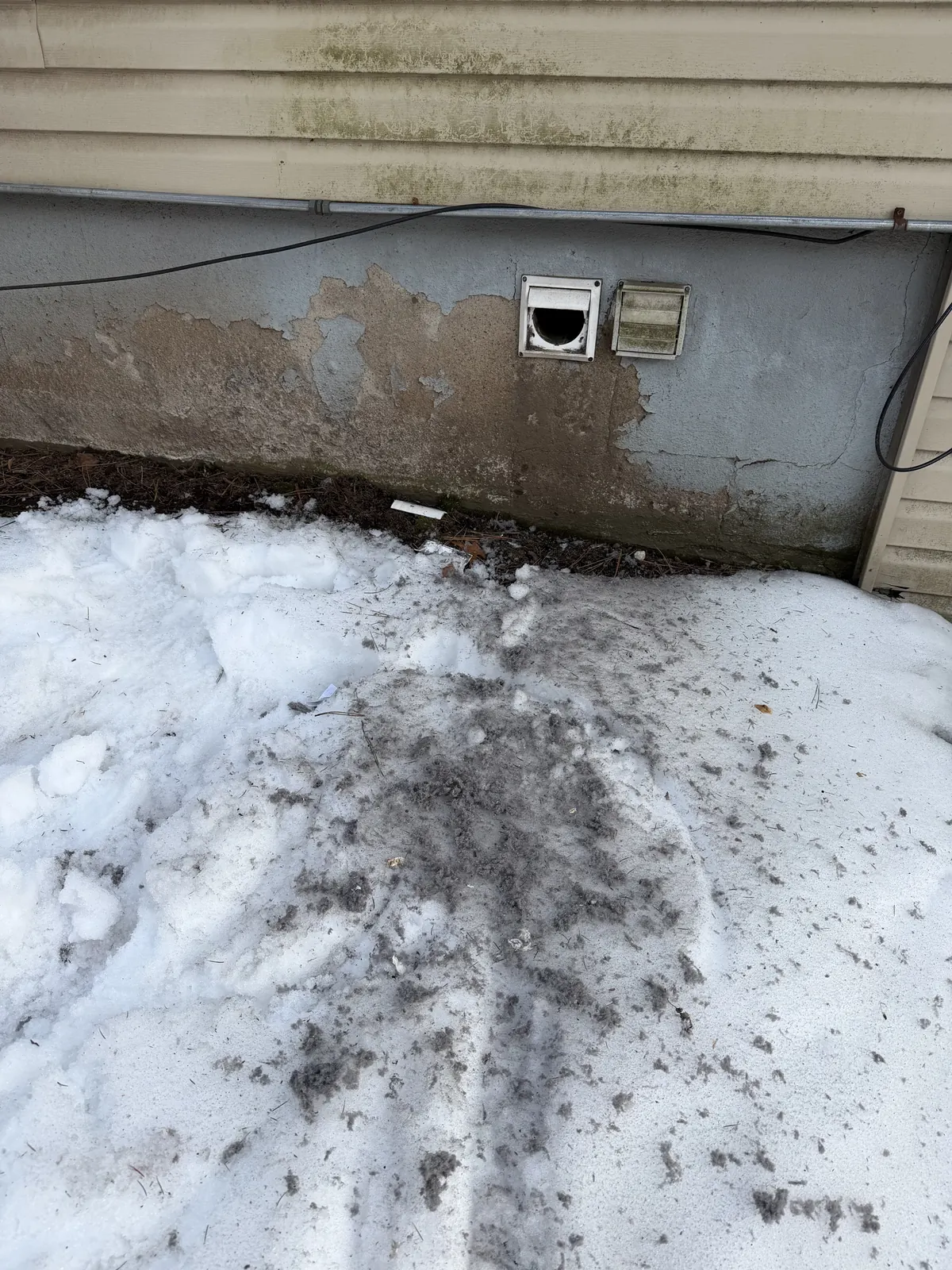
Start behind the machine and follow the duct. If it runs to an outside wall and ends in a hood whose flap opens when the dryer runs, the chimney is not involved. If it disappears into the masonry, into a round opening with a metal collar, or into a small iron cleanout door, the dryer is venting into a flue. Other clues are lint mixed into the soot when the cleanout door at the bottom of the chimney is opened, fuzz caught around the top of the chimney, a basement that turns muggy on laundry days, and no dryer hood anywhere on the outside of the house.
The fix, in order
The dryer gets its new path first. With dryer vent installation, a run of rigid metal duct takes the most direct line the joists allow to an outside wall, usually leaving through the wood rim joist on top of the foundation rather than the stone below it, and it ends at a hood with a backdraft flap and no screen, which is what the state's code asks of every dryer termination. Behind the machine, a short metal connector takes the place of any foil or vinyl hose.
Next, the opening in the chimney gets closed for good. Pulling the dryer duct out of a thimble leaves a hole straight into the flue, and a strip of tape or a loose metal plate will not seal it. The crew fills the opening with masonry so the flue is whole again and holds its draft without pulling basement air or leaking exhaust.
Then the flue is swept. Chimney cleaning brushes the lint off the flue walls and empties the base of the chimney, and the inspection that goes with it looks at the tiles and joints for damage from years of wet exhaust. If the flue also serves a boiler or a water heater, any liner work gets planned at that point, and your heating company can recheck the appliance's draft once the dryer is out of the chimney.
Two jobs that stay apart
A dryer and a chimney do different jobs. The dryer uses a small fan to push wet air and lint a short distance to the outside, while a chimney lifts hot combustion gases above the roof on draft alone. The code keeps the two apart for that reason. Once the dryer has its own run and its own hood, it goes on the routine any dryer vent follows: a clean lint screen before or after every load, as the NFPA advises, and a cleaning of the run when drying starts to slow.
Sources
- NFPA: Clothes Dryer Safety
- CPSC: Carbon Monoxide Questions and Answers
- U.S. Census Bureau, American Community Survey 2020 to 2024, year structure built, Hunterdon County and High Bridge borough (Census Reporter)
- U.S. Census Bureau, American Community Survey 2020 to 2024, house heating fuel, Hunterdon County and High Bridge borough (Census Reporter)
- National Park Service: National Register nomination, Stanton Historic Rural District
- Readington Township: Historic Districts
- New Jersey One- and Two-Family Dwelling Subcode 2024 (IRC 2024, New Jersey edition): sections M1502.2 and M1502.3, dryer exhaust, text on UpCodes