
Sometimes, and it depends on two things that do not always agree with each other: what the dryer's own instructions allow, and what local code requires for the garage itself. A gas dryer installed in an attached garage has to keep its burner at least 18 inches above the floor under New Jersey's fuel gas rules, unless the unit is listed by its maker as resistant to flammable vapors, in which case that height rule does not apply. Either way, the vent still has to travel out of the garage and end outdoors, the same as a vent from any other room in the house.
Check the dryer's manual before the garage
Before any of the code questions, the dryer's own installation manual gets the first word. Several major makers note that some local codes limit or restrict installing a dryer in a garage at all, and the manual will say so directly if that model falls under a restriction. That instruction sheet is written for the specific unit, including its vapor resistance rating if it has one, and it is worth pulling out and reading before a dryer gets set on a garage floor rather than after.
The 18-inch rule for a gas dryer's burner
New Jersey's fuel gas subcode keeps an ignition source like a gas dryer's burner at least 18 inches above the garage floor, since gasoline vapor and other flammable fumes that can collect in a garage sit low to the ground and a pilot or burner down near floor level sits right where that vapor pools. A dryer listed as resistant to flammable vapors is built to keep ignition sources sealed off from that same vapor, and a unit carrying that listing is exempt from the height rule. An electric dryer has no burner or pilot, but it still sits in the same garage, and the vent routing rules below apply to it the same as to a gas model.
Getting the vent out of an attached garage
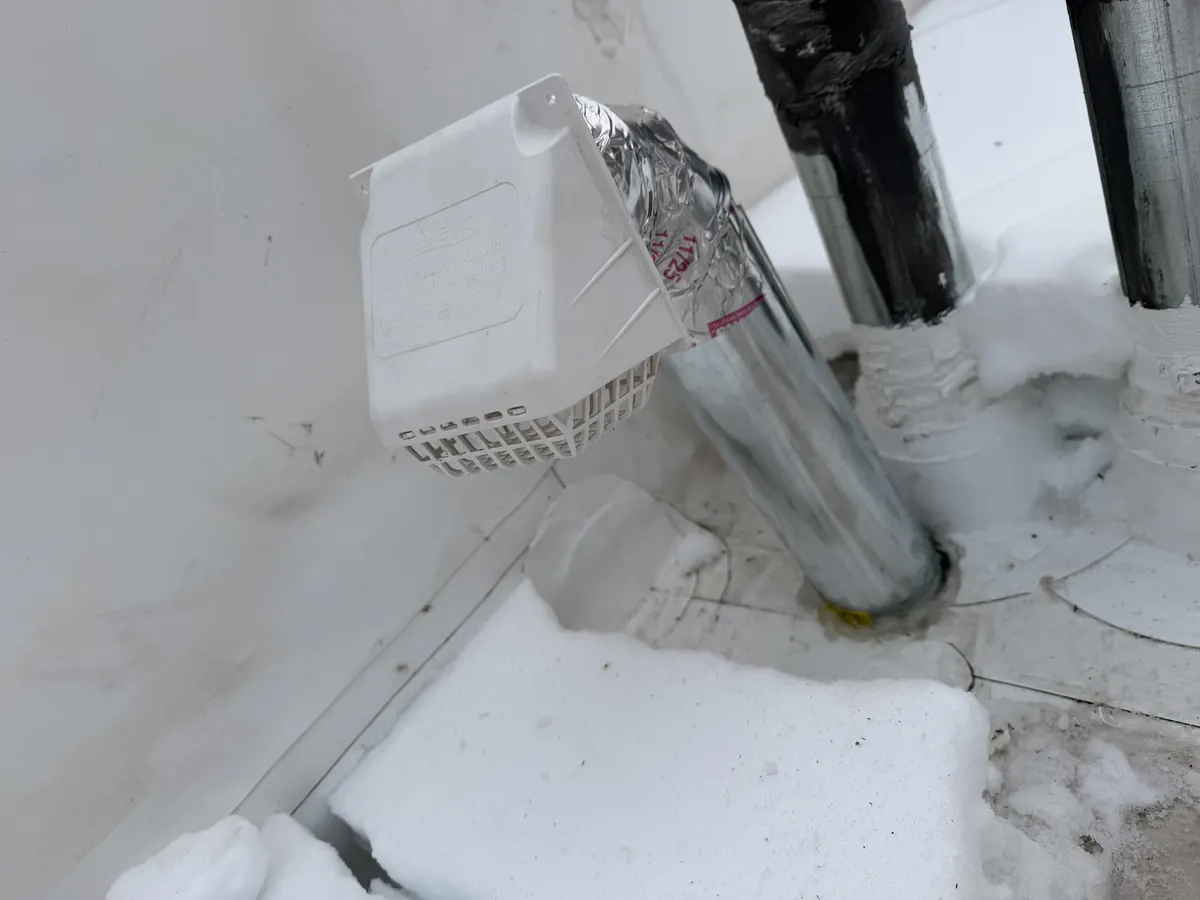
The simplest run takes the vent straight out through an exterior garage wall to a hood on the outside, the shortest distance with the fewest turns. That keeps the whole duct run inside a space that is already separated from living areas, and it avoids the fire separation questions that come up the moment a vent crosses from the garage into the house itself. For a dryer set against an exterior wall, that straight-out run is usually the one worth building toward even if the current laundry hookup sits somewhere else in the garage.
If the run has to cross into the house
Some garage layouts do not leave a clear path to an exterior wall, and the vent has to pass through the wall or ceiling separating the garage from the house to reach an outside hood. That is allowed, but only in rigid galvanized steel or aluminum duct, never flexible foil transition duct, and the fire separation between garage and house has to stay intact around the penetration. The gap where the duct passes through gets sealed the way the code's fireblocking rule requires, closing off the opening rather than leaving a hole packed loosely with insulation or left open around the duct. A fire damper does not belong in a dryer vent duct. A damper like that restricts airflow the dryer depends on to clear moist air and lint, and it gives lint a ledge to collect on inside the duct where it is hardest to reach during a cleaning.
Keeping the dryer clear of a parked car
A dryer sitting in a private garage also has to stay out of the path a parked vehicle could strike. That usually means setting the appliance up on a platform or shelf high enough to clear a bumper, commonly around 6 feet off the floor, or protecting it at floor level with a physical guard such as a post or a curb the car cannot reach past. Either approach keeps a fender from clipping the dryer cabinet or its vent connection during an ordinary pull into the garage, which matters as much for the vent duct attached to the back of the unit as for the appliance itself.
Cold, damp, and lint on everything stored nearby
An unheated garage runs colder and damper than the rest of the house through a New Jersey winter, and a dryer working in that cold air takes longer to bring a load to full dry than the same dryer would inside a heated laundry room. Moist exhaust air condensing on a cold duct run adds dampness to a garage that already holds more of it than a conditioned room does, and lint that escapes a loose duct joint settles on whatever is stored nearby, from cardboard boxes to tools on a shelf. A vent run built with solid metal duct and tight joints from the start cuts down on both problems, since a tight run loses less warm moist air along the way and gives lint less chance to escape before it reaches the outside hood.
Raritan Township and Readington's garage-heavy subdivisions
Raritan Township's population nearly doubled between 1980 and 1990, and a lot of the subdivisions built during that stretch, along with similar developments in Readington from the same building boom, came with an attached two-car garage as standard. Houses from that era often put the laundry hookup in the garage itself or along a wall shared with it, and the vent runs built then do not always match what current routing and duct material rules call for, especially where a run crosses into the house through a shared wall. Dryer Vent Installation can review a run like that against the current layout, move the hookup closer to an exterior wall where that shortens the path, and rebuild the duct in solid metal with the fire separation sealed properly where it has to cross into living space.