Dryer Vent Installation in Readington and Hunterdon County
A dryer vent installation builds a new run from the dryer to the outside in rigid metal duct, by the shortest route the house allows, and ends it in a cap that opens for the exhaust and closes against weather and animals.
Cleaning cannot fix a run that was built wrong. A vent that is longer than the dryer can push through, one with four elbows where two would do, foil or vinyl duct buried in a wall, or a run that ends in a crawl space or an attic will restrict the exhaust however recently the lint was cleared. Hunterdon houses produce all of these. When a farmhouse renovation moves the laundry up from a fieldstone basement to a mudroom or the second floor, the old vent goes nowhere useful, and a larger house with an upstairs laundry may have been built with a long climb to the roof from day one.
The work itself is part carpentry and part airflow. The route has to fit the framing, respect the length limit the dryer's maker sets, and end in a cap placed where snow, walkways and the outdoor air conditioning unit will not interfere. Below is how AMG Duct Cleaning Readington NJ chooses the route and the material, handles stone walls and upstairs laundries, places the cap, and handles installation day.
Choosing the route and the material
The dryer in your laundry room came with a limit: its maker prints how long the vent may run, and every elbow takes a bite out of that number. The crew reads the limit for your dryer before planning anything, then looks for the shortest path to an outside wall or the roof with the fewest turns. The wall that looks nearest from the yard is not always the shortest run once the joists are counted, so the planning happens with a tape measure in the basement or the attic, not from the driveway. A route that zigzags between framing members costs airflow at every bend.
The duct is rigid metal, smooth inside so lint has nothing to catch on, and the National Fire Protection Association's tip sheet on dryers asks for metal venting material for the same reason: proper airflow and drying time. Sections are joined with foil tape rather than screws, since a screw tip poking into the duct becomes a hook for lint. The only flexible piece is the short transition behind the machine, and that is semi-rigid metal, never the foil or vinyl accordion hose that sags and crushes. Every joint points the right way, crimped end toward the outside, so fibers slide past instead of snagging on an edge.
Stone foundations, upstairs laundries and cold attics
A laundry in the basement of an older farmhouse often sits against a fieldstone wall two feet thick. Coring through the stone is the last choice; the crew looks first for a route through the wood rim joist that sits on top of the foundation, which is thinner, easier to seal and simpler to patch if the vent ever moves again. Where the only way out is through the stone itself, the options and what each involves are explained before anything is scheduled.
An upstairs laundry usually exits through the attic, either straight up to a roof cap or across to a gable wall when that is shorter. The run is supported at close intervals so it stays straight. In an unheated Hunterdon attic it is also wrapped, because warm, wet exhaust meeting cold metal in January condenses inside the duct, and that water runs back toward the dryer and turns lint into paste. When no route comes in under the dryer's length limit, a booster fan sized for the run is the last resort, and the crew says so plainly, since a vent the dryer cannot clear is not worth installing.
Caps, snow lines and historic fronts
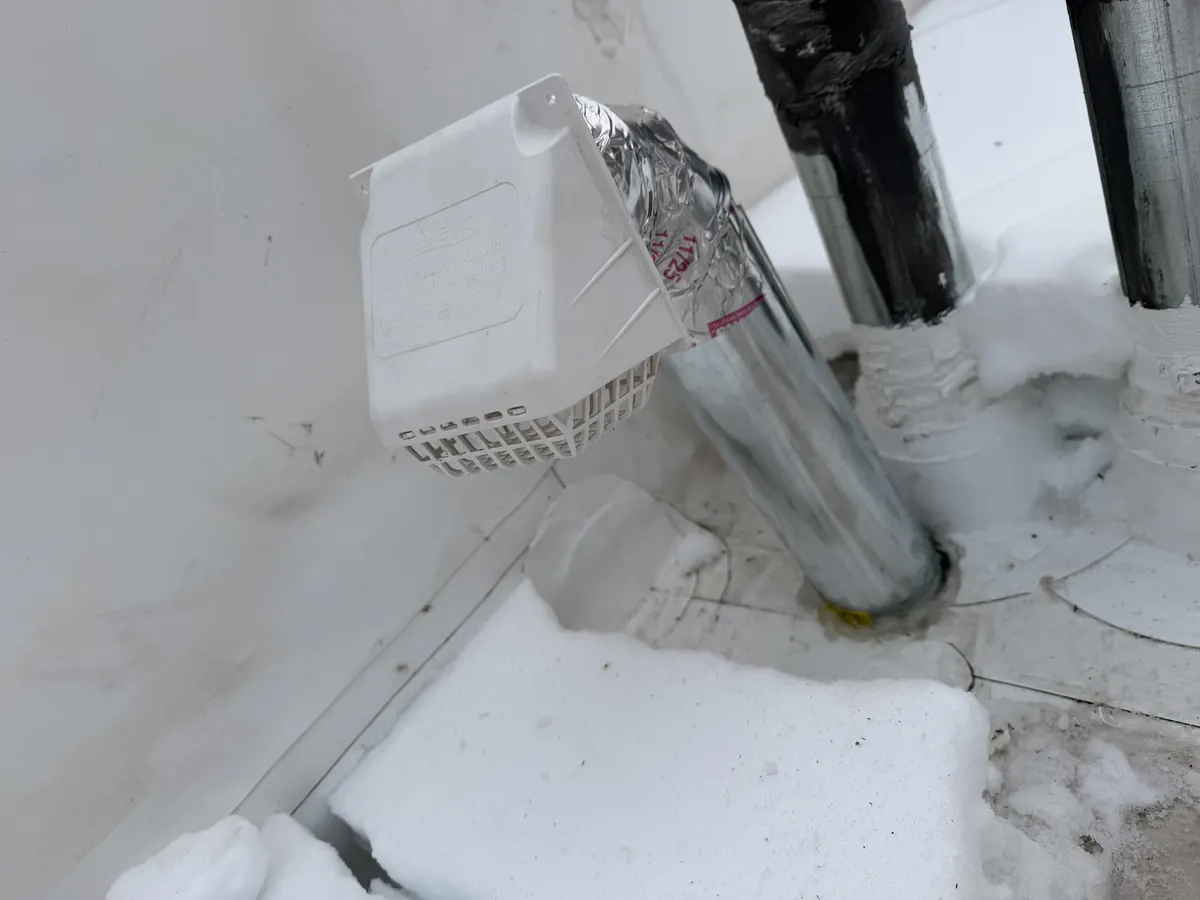
The cap on the outside is a hood with a damper flap and nothing across the opening, since any mesh at the end of a dryer run chokes on the first season of lint. The NFPA sheet reminds homeowners to check that the outdoor flap is not covered by snow, so the crew sets a wall cap well above the drift line and away from windows, doors, decks and the outdoor unit of the air conditioner, whose coil would otherwise collect lint every time the dryer runs. On a roof, the cap is one made for dryers, with a flap, never a plumbing vent reused for the job.
Where the house sits in a historic district, the cap goes on a side or rear wall whenever the layout allows. Exterior alterations in Flemington's historic district go before the borough's Historic Preservation Commission, and Readington's own commission advises on changes to historic structures in villages such as Stanton, Pleasant Run and Three Bridges. A quick call to the borough or the township before the work is booked settles whether a new opening on a visible wall requires review.
Townhouses, associations and the day of the work
In a townhouse or condominium community, the association usually decides where a new opening may go and wants paperwork first. If the board or its manager asks for proof of coverage, AMG sends its insurance certificate before the crew arrives. The route is then drawn inside the association's rules, which sometimes means a longer but permitted path instead of the shortest one, and the crew tells you when those rules push a run past the dryer's limit. Where two neighbors share a wall, the cap is kept well away from the unit next door.
On the day, the route is walked once more, the opening is cut and sealed, a roof cap is flashed into the shingles, and the old opening is closed so it does not leak air or let animals in. The dryer runs on high at the end while someone confirms airflow at the new cap. A remodel that opens walls anyway is the moment to settle any air duct installation for the same rooms, and if part of the old vent is kept, a dryer vent cleaning clears it before it is tied in. AMG is veteran owned, licensed and insured, NJ HIC 13VH13654300; the Readington location plans installations 8 AM to 8 PM, 7 days a week, and the free estimate includes a walk of the route.
What is included
- The dryer maker's length limit checked for your model
- Shortest route with the fewest elbows the framing allows
- Rigid metal duct, joints taped rather than screwed
- Semi-rigid metal transition behind the dryer
- Attic runs supported and wrapped against condensation
- Dryer-rated cap with a damper flap and no screen
- Cap set above the snow line and clear of the AC unit
- Old opening closed and the new one sealed or flashed
Questions and answers
Can a dryer vent go out through a stone foundation?
It can, but a route through the wood rim joist above the stone is usually cleaner and easier to seal. The crew looks for that first and explains the options if the only way out is through the stone itself.
What is the longest a dryer vent can run?
As long as your dryer's maker allows, and that figure shrinks for every elbow. The limit is printed in the installation instructions for your model, and the crew checks it before any route is drawn.
Do I need a booster fan?
Only when no shorter route exists. A fan sized for the run can carry a long climb to the roof, but it adds a part that draws power and wants upkeep, so every routing option gets a look first.
Where should the outside vent cap go?
Above the snow line, away from windows, doors, decks and the air conditioner's outdoor unit, and on a side or rear wall when the house is in a historic district. When the laundry is upstairs and the roof is the shortest way out, a roof cap made for dryers is used.
Can you replace a foil or plastic dryer vent?
Yes. Foil and vinyl accordion duct inside a wall or ceiling is replaced with rigid metal, and a crushed hose behind the machine is swapped for semi-rigid metal. It is often the first thing a cleaning visit flags.
More questions and answers about our work
Dryer Vent Installation across Hunterdon County
We provide dryer vent installation in Hunterdon County. Choose your town for local details.
Ready for cleaner air?
Tell us about your home and get a free estimate.