A dryer vent in a New Jersey house has to follow the dryer maker's instructions first, and the state's residential code second. Both are written to keep the exhaust moving: the code's section on clothes dryer exhaust, M1502, covers the duct material, its size, its maximum length, the hose behind the machine and the cap outside. The section numbers below come from the One- and Two-Family Dwelling Subcode of the New Jersey Uniform Construction Code, which has adopted the 2024 International Residential Code, New Jersey edition, since August 17, 2026. For six months after a subcode revision, a complete permit application may still be reviewed under the edition it replaced, the 2021 code, so ask the township construction office which edition applies to your permit. Section M1502 reads the same in both editions.
Start with the manual
Section M1502.1 is one sentence: clothes dryers shall be exhausted in accordance with the manufacturer's instructions. Everything after it fills in what applies when the instructions say nothing, or when an inspector asks for the numbers. The manual for your dryer lists the vent length it allows, the duct it expects and where the exhaust may end, so it is the first document to read before a run is planned.
Makers do not agree with each other. One manufacturer's venting guide allows a run of up to 65 feet in 4-inch rigid metal duct with no elbows, and takes 6 feet off for each added elbow. The code's own default is much shorter, as the next section shows. Section M1502.4.6.2 lets the duct size and length follow the manufacturer's instructions, and the code official must be given a copy of those instructions at the concealment inspection. Without the maker's fitting calculations, the code's table applies.
Duct material, size and support
Under M1502.4.1 the duct has a smooth interior and is made of metal at least 0.0157 inch thick, which is No. 28 gage, and it is 4 inches in nominal diameter. Foil and vinyl are not on that list. The National Fire Protection Association's dryer safety tip sheet asks for rigid or flexible metal venting for the same reason, to sustain proper air flow and drying time.
Section M1502.4.2 covers how the duct goes in. It is supported at intervals not longer than 12 feet, the joints are sealed and mechanically fastened, and a fastener may not stick more than one eighth of an inch into the duct, since a screw tip inside the pipe gives lint something to catch on.
The 35 foot default and what elbows cost
Under M1502.4.6.1 the maximum length of the exhaust duct is 35 feet, measured from the transition duct connection to the outlet terminal, and the transition duct is not counted. Elbows come off that figure, and the code gives an equivalent length for each. A 4-inch radius mitered 90 degree elbow counts as 5 feet, and a 4-inch radius mitered 45 degree elbow counts as 2 feet 6 inches. A 6-inch radius smooth 90 degree elbow counts as 1 foot 9 inches. Smooth, wide-radius elbows cost far less length than the sharp mitered kind, which is why the choice of fitting matters in a long run.
A run is allowed to exceed 35 feet of equivalent length when the dryer maker's instructions permit it, and where the equivalent length goes over 35 feet, M1502.4.7 asks for a permanent label or tag within 6 feet of the duct connection that states the figure. Domestic booster fans may not be added to a dryer exhaust under M1502.4.5.
The transition hose behind the dryer
The short piece between the dryer and the wall pipe has its own rule. Under M1502.4.3 it is a single length of transition duct listed and labeled to UL 2158A, no longer than 8 feet, and it may not be concealed inside the construction. A hose that disappears into a wall is outside the code, and so is a loose foil hose spliced from two lengths.
Where the vent ends
The duct ends on the outside of the building. When the dryer maker gives a location, that is where it goes. When the manufacturer's instructions do not specify one, M1502.3 puts the termination at least 3 feet in any direction from openings into the building, and that includes ventilated soffit openings. The termination has a backdraft damper, and screens shall not be installed at the termination. Section M1502.3.1 asks that the outlet and its passageway stay undiminished in size, with an open area of at least 12.5 square inches.
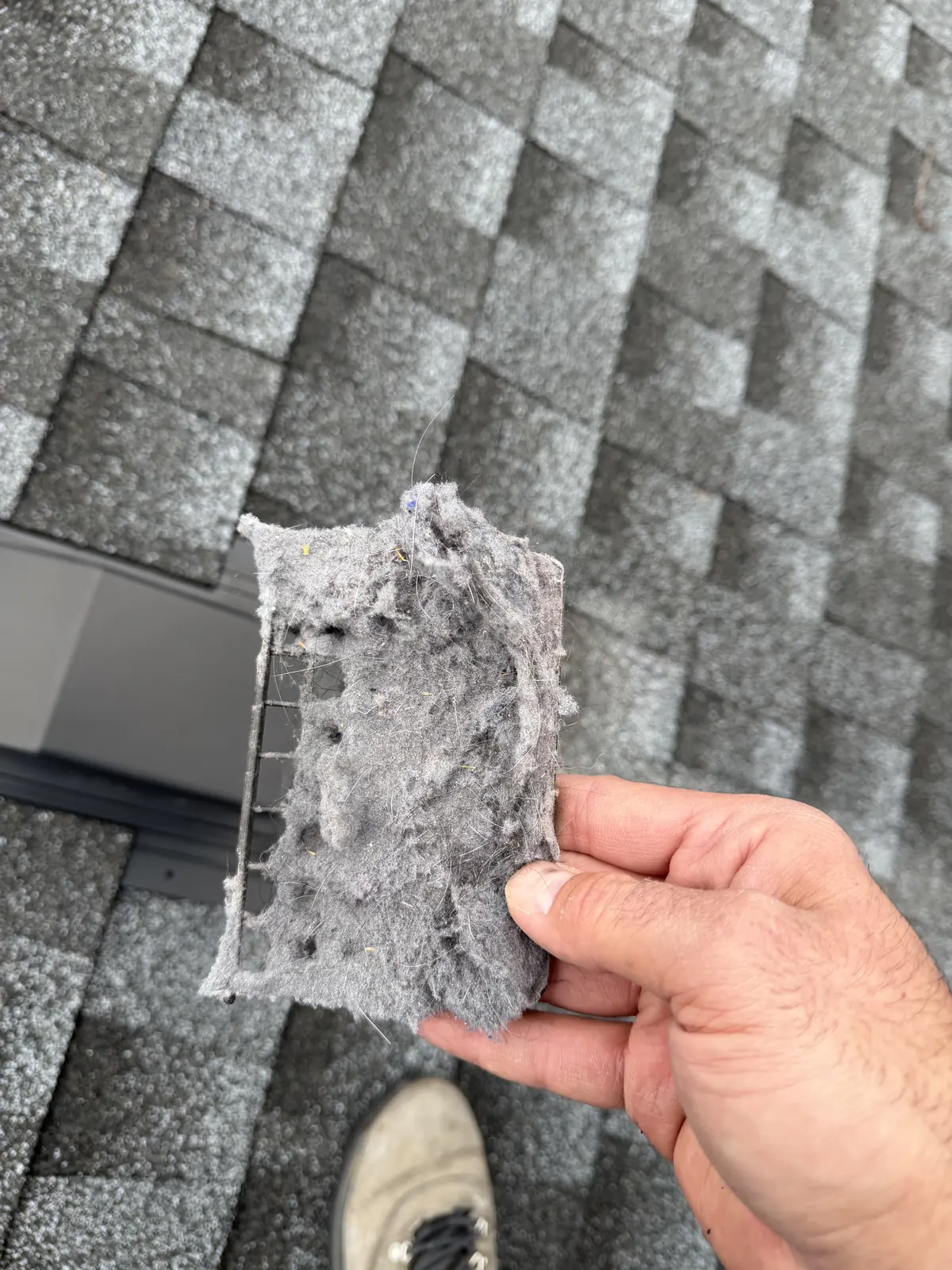
The no-screens rule has a practical side. Fine mesh over a dryer cap fills with lint within a season, and the exhaust backs up behind it. Section M1502.2 adds that the dryer exhaust is independent of all other systems and carries the moisture to the outdoors, which rules out venting into a crawl space, an attic or the garage.
Where the vent passes through framing and in new construction
Section M1502.5 requires a steel shield plate where finish fasteners could reach the duct, and where the duct sits less than 1 and one quarter inches from the finished face of the framing. The plate is at least 0.062 inch thick and runs at least 2 inches above the sole plate and below the top plate. A run set in a stud wall for an upstairs laundry is the typical place it applies.
In new construction, M1502.4.8 requires an exhaust duct wherever space for a dryer is provided. If no dryer is installed when the house is occupied, the duct is capped or plugged, identified and marked for future use. The one exception is a listed condensing clothes dryer installed before occupancy, since a ductless machine has no vent.
What this means for a Readington or Hunterdon house
Many houses in Readington and the towns around it have a laundry upstairs or in the middle of the floor plan, far from an outside wall, and a long run with elbows is common. The arithmetic in M1502.4.6.1 is worth doing before a new run is planned: measure the path, count the turns, convert each one with the code's table, and compare the total against 35 feet and against the limit in the dryer's own manual. A farmhouse with a laundry added to a back room may have a short, straight route out. A colonial with a second floor laundry may need the manual's longer allowance to pass.
A cleaning cannot fix a run that is too long or built in foil, and a new run built to these numbers saves a second visit. The NFPA tip sheet also says to have a dryer installed and serviced by a professional, to clean lint out of the vent pipe once a year or sooner when drying slows, and to make sure the outdoor flap is not covered by snow, which is a real concern on a low cap in a Hunterdon winter.
For a specific house, the manual for your dryer and the code official who reviews the work have the last word on the numbers above. If a run needs to be planned or rebuilt in rigid metal to those limits, that is the work of Dryer Vent Installation, and once the run is in place, Dryer Vent Cleaning keeps it clear.
Sources
- New Jersey One- and Two-Family Dwelling Subcode 2021 (IRC 2021, New Jersey edition): section M1502, clothes dryer exhaust, text on UpCodes
- NFPA, Clothes Dryer and Washing Machine Safety tip sheet, hosted by the U.S. Department of Energy
- LG Electronics, proper dryer venting and installation tips: maximum vent length by number of elbows